.png)
Our Philosophy
A carefully designed blend, not a trend
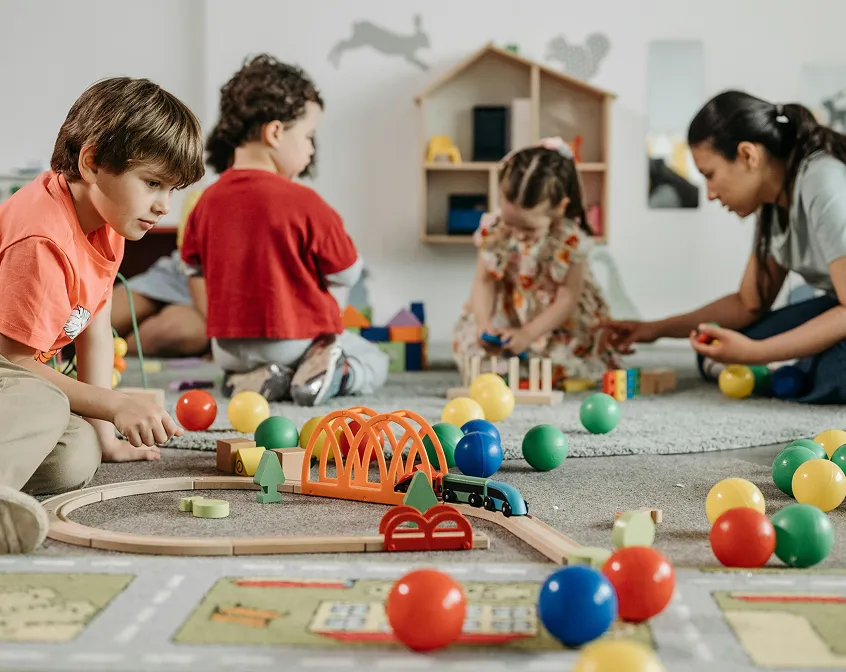
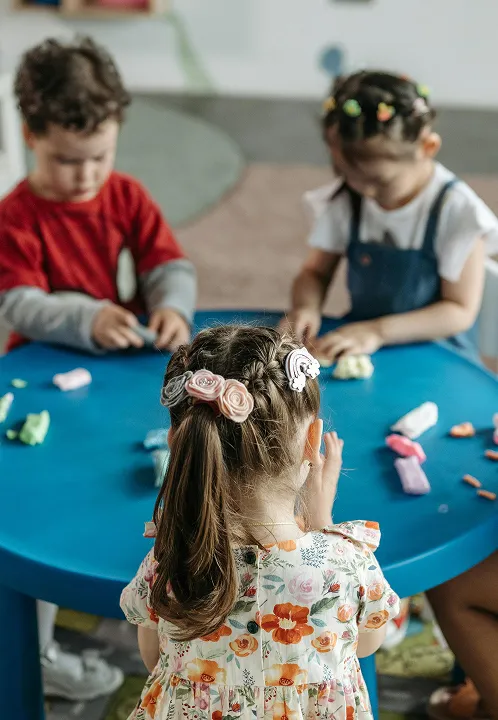

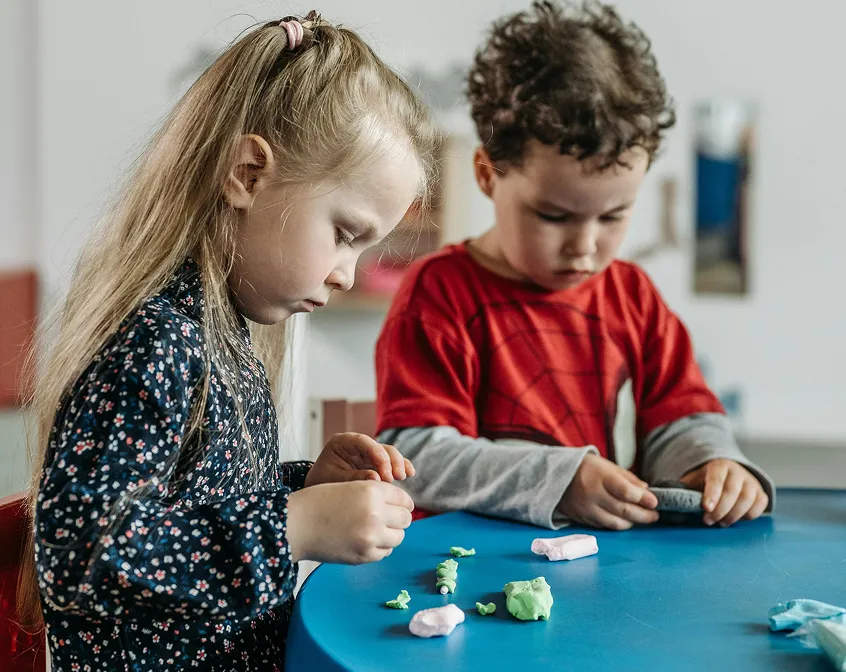
What Does a research-based evidence-backed blended curriculum solves?
Research on different education models is mixed and results vary, there isn’t one clear answer for everyone. That’s why we don’t follow just one rigid label.
Instead, we’ve designed our own research-backed approach based on what we actually do every day, rather than claiming that a single purist model is “best” for every child.
This solves a real tension that many families and teachers feel with having to choose one tool. It also helps children grow into capable, independent, and wildly creative individuals.
Instead, we’ve designed our own research-backed approach based on what we actually do every day, rather than claiming that a single purist model is “best” for every child.
This solves a real tension that many families and teachers feel with having to choose one tool. It also helps children grow into capable, independent, and wildly creative individuals.

Reggio protects curiosity and deep inquiry.
Children’s ideas become real projects, and learning becomes visible through documentation and the environment.

Montessori gives independence, patience, and life skills.
Children learn to do things for themselves, build focus, and rely less on instant gratification.

Waldorf protects imagination and rhythm.
Children feel safe in predictable patterns, and storytelling/nature nourish creativity and emotional development.
We slow down the pace of the city to create space for curiosity, kindness, and calm discovery.
From Reggio
WHAT WE TAKE:
• Open-ended “atelier-style” materials: baskets of blocks, fabric, clay, wire, tape, natural objects, light and shadow tools, mirrors, ramps, and tubes. These materials are meant to be combined and recombined, not used in just one “right” way.
• Provocations and invitation-to-play tables: small, curated setups that spark a question, such as “How can we build a bridge that holds 10 stones?” rather than step-by-step crafts.
• Child-led projects: teachers capture children’s interests and turn them into project arcs that unfold over days or weeks. Vocabulary, counting, fine motor skills, and social learning are woven in naturally.
• Documentation panels: photos, child quotes, and brief teacher notes that show the learning process — what we tried, what we noticed, and what we’re wondering next. This allows families to see thinking, not just finished products.
• Environment as the “third teacher”: calm, beautiful, intentionally organized spaces that invite collaboration, independence, and deep focus. This includes small-group tables, cozy reading corners, and accessible materials.
WHAT WE DO NOT TAKE:
• The expectation that the day is mostly “emergent” with minimal predictable structure: We keep the child-led inquiry, but we place it inside a consistent daily rhythm (Waldorf).
• Open-ended “atelier-style” materials: baskets of blocks, fabric, clay, wire, tape, natural objects, light and shadow tools, mirrors, ramps, and tubes. These materials are meant to be combined and recombined, not used in just one “right” way.
• Provocations and invitation-to-play tables: small, curated setups that spark a question, such as “How can we build a bridge that holds 10 stones?” rather than step-by-step crafts.
• Child-led projects: teachers capture children’s interests and turn them into project arcs that unfold over days or weeks. Vocabulary, counting, fine motor skills, and social learning are woven in naturally.
• Documentation panels: photos, child quotes, and brief teacher notes that show the learning process — what we tried, what we noticed, and what we’re wondering next. This allows families to see thinking, not just finished products.
• Environment as the “third teacher”: calm, beautiful, intentionally organized spaces that invite collaboration, independence, and deep focus. This includes small-group tables, cozy reading corners, and accessible materials.
WHAT WE DO NOT TAKE:
• The expectation that the day is mostly “emergent” with minimal predictable structure: We keep the child-led inquiry, but we place it inside a consistent daily rhythm (Waldorf).
From Montessori
WHAT WE TAKE:
• Independence, dignity, and real-life competence: children practice caring for themselves and their environment, such as pouring, cleaning, dressing frames, and plant care. Practical life is a cornerstone.
• A prepared child-sized & orderly environment: low shelves, limited choices per shelf, everything has a home, children can access materials without adult gatekeeping.
• Self-correcting, hands-on materials: materials that give feedback through use, so the child doesn’t need constant adult correction.
• Uninterrupted independent work time: a protected block where children choose work, build stamina, and experience “I can do hard things.”
• Freedom within limits: clear ground rules + choice inside boundaries.
WHAT WE DO NOT TAKE:
• A strict “realism only” approach to imagination: we do not avoid fantasy, silly stories, or imaginative art. We intentionally include “purple giraffe” creativity—because imagination is not fluff; it’s language, social development, problem-solving, and joy.
• A rigid one-method-only material diet: Montessori materials are powerful, but we won’t limit children to only one sanctioned set of works. We also use open-ended materials and project tools (Reggio) and storytelling/art (Waldorf).
• Mixed ages as a requirement: mixed ages can be wonderful, but we treat it as a design choice, not a purity test.
• Independence, dignity, and real-life competence: children practice caring for themselves and their environment, such as pouring, cleaning, dressing frames, and plant care. Practical life is a cornerstone.
• A prepared child-sized & orderly environment: low shelves, limited choices per shelf, everything has a home, children can access materials without adult gatekeeping.
• Self-correcting, hands-on materials: materials that give feedback through use, so the child doesn’t need constant adult correction.
• Uninterrupted independent work time: a protected block where children choose work, build stamina, and experience “I can do hard things.”
• Freedom within limits: clear ground rules + choice inside boundaries.
WHAT WE DO NOT TAKE:
• A strict “realism only” approach to imagination: we do not avoid fantasy, silly stories, or imaginative art. We intentionally include “purple giraffe” creativity—because imagination is not fluff; it’s language, social development, problem-solving, and joy.
• A rigid one-method-only material diet: Montessori materials are powerful, but we won’t limit children to only one sanctioned set of works. We also use open-ended materials and project tools (Reggio) and storytelling/art (Waldorf).
• Mixed ages as a requirement: mixed ages can be wonderful, but we treat it as a design choice, not a purity test.
From Waldorf

WHAT WE TAKE:
• Daily predictable rhythm: the day “breathes” between active and quiet, inside and outside, child-led and teacher-led. This is our structure-for-transitions piece.
• Storytelling + oral language: teacher-told stories, puppetry, seasonal tales, and rich read-alouds that invite imagination; not just comprehension questions.
• Imagination as a core learning tool: open-ended dramatic play, loose parts, costume baskets, story acting, art that values expression over “perfect products.”
• Daily, not occasional, nature emphasis: outdoor time every day, nature walks, gardening, sensory experiences, seasonal themes.
• Limited screen time, especially for early childhood: we prioritize real-world, hands-on, relationship-based learning and keep screens minimal and intentional.
WHAT WE DO NOT TAKE:
• We don’t avoid early literacy/numeracy experiences entirely: we deliver them in developmentally appropriate ways (hands-on, meaningful, playful, brief teacher-led moments), rather than pushing worksheets or long whole-group academics.
• Daily predictable rhythm: the day “breathes” between active and quiet, inside and outside, child-led and teacher-led. This is our structure-for-transitions piece.
• Storytelling + oral language: teacher-told stories, puppetry, seasonal tales, and rich read-alouds that invite imagination; not just comprehension questions.
• Imagination as a core learning tool: open-ended dramatic play, loose parts, costume baskets, story acting, art that values expression over “perfect products.”
• Daily, not occasional, nature emphasis: outdoor time every day, nature walks, gardening, sensory experiences, seasonal themes.
• Limited screen time, especially for early childhood: we prioritize real-world, hands-on, relationship-based learning and keep screens minimal and intentional.
WHAT WE DO NOT TAKE:
• We don’t avoid early literacy/numeracy experiences entirely: we deliver them in developmentally appropriate ways (hands-on, meaningful, playful, brief teacher-led moments), rather than pushing worksheets or long whole-group academics.
“InBloom is exactly what an early childhood program should be. We’ve seen our child’s curiosity and confidence grow so much. Thanks to Ms. Tori, our child sees themselves as a capable, confident learner, and the care she puts into every child is what truly makes this place special.”

Educator Spotlight

Co-Founder & Lead Educator
Tori Jensen
Working with children has shaped the majority of my education and my career.
Having been a state-ranked gymnast myself, I began coaching gymnastics at a young age, guiding children from six months through ten years old. It was there I learned how to kneel to a child’s level, celebrate small victories, and gently encourage bravery. I saw firsthand how movement builds confidence.
I later earned my B.Sc. in Early Childhood Education while teaching full-time in private preschool classrooms in multiple states. Over the years, I’ve worked across different school environments and philosophies, continuing my education through graduate coursework and professional development, including studies at the Harvard Graduate School of Education.
What matters most to me, though, is not the label of a method; it is the moment a child realizes, “I can do this.” I love working with children and design classrooms intentionally so that my kids feel safe, respected, and capable. Because ultimately, those are the conditions where true growth happens.
Having been a state-ranked gymnast myself, I began coaching gymnastics at a young age, guiding children from six months through ten years old. It was there I learned how to kneel to a child’s level, celebrate small victories, and gently encourage bravery. I saw firsthand how movement builds confidence.
I later earned my B.Sc. in Early Childhood Education while teaching full-time in private preschool classrooms in multiple states. Over the years, I’ve worked across different school environments and philosophies, continuing my education through graduate coursework and professional development, including studies at the Harvard Graduate School of Education.
What matters most to me, though, is not the label of a method; it is the moment a child realizes, “I can do this.” I love working with children and design classrooms intentionally so that my kids feel safe, respected, and capable. Because ultimately, those are the conditions where true growth happens.
Watch your little one bloom.